A PROPOSAL FOR BETTER PUBLIC SYSTEMS
AI & Immigration
Less avoidable waiting. Better-prepared applications. Human judgment where it matters.
Policy proposal · October 2026 · Not an agency service or an individual case estimate
THE COMPLETE PROPOSAL
The full proposal PDF
Moving Spousal Immigration Processing from Years to Weeks
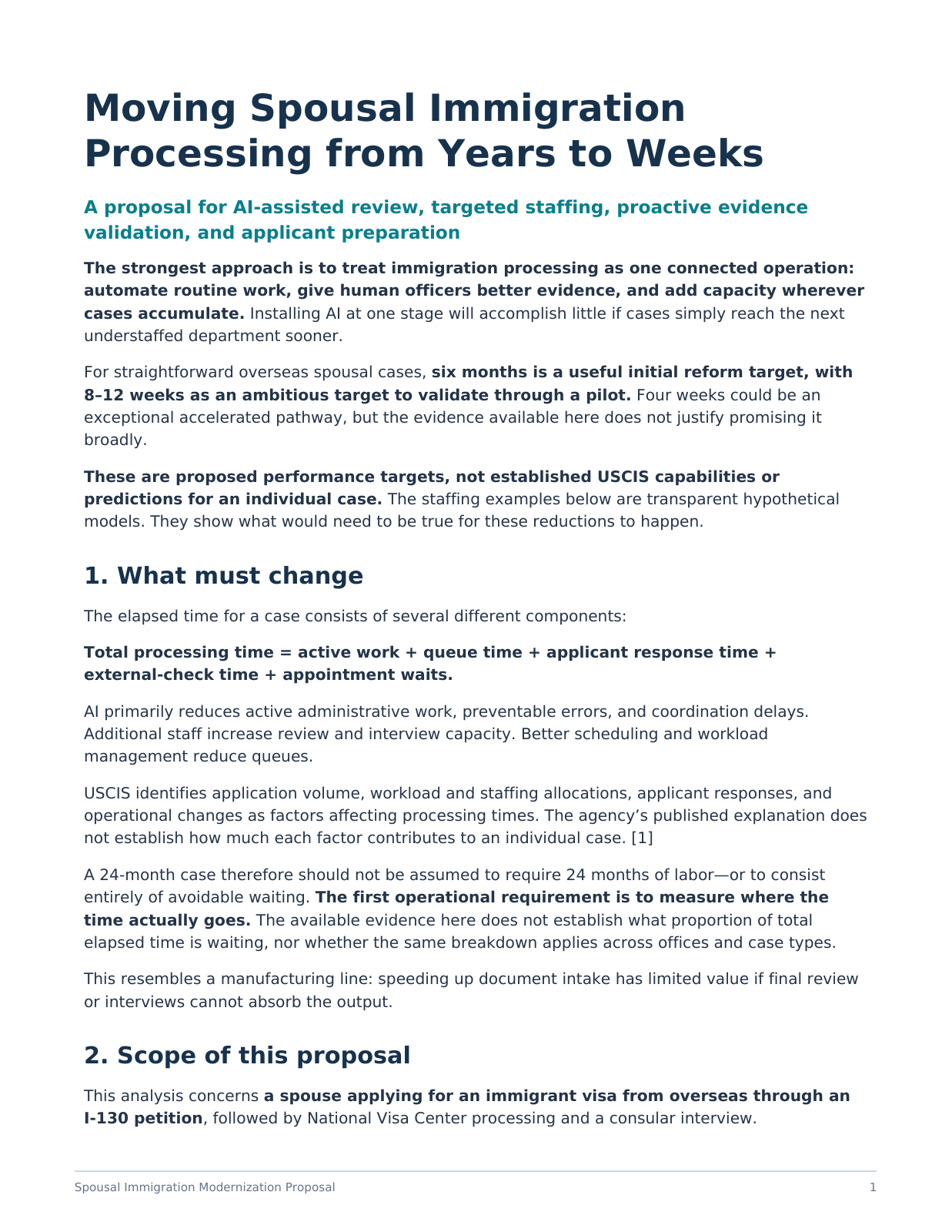
Read all 27 pages here using Previous, Next, or the page selector. You can also download the original PDF or read the full text below.
Page 1 of 27
Read the full document as text
Moving Spousal Immigration
Processing from Years to Weeks
A proposal for AI-assisted review, targeted staffing, proactive evidence
validation, and applicant preparation
The strongest approach is to treat immigration processing as one connected operation:
automate routine work, give human officers better evidence, and add capacity wherever
cases accumulate. Installing AI at one stage will accomplish little if cases simply reach the next
understaffed department sooner.
For straightforward overseas spousal cases, six months is a useful initial reform target, with
8–12 weeks as an ambitious target to validate through a pilot. Four weeks could be an
exceptional accelerated pathway, but the evidence available here does not justify promising it
broadly.
These are proposed performance targets, not established USCIS capabilities or
predictions for an individual case. The staffing examples below are transparent hypothetical
models. They show what would need to be true for these reductions to happen.
1. What must change
The elapsed time for a case consists of several different components:
Total processing time = active work + queue time + applicant response time +
external-check time + appointment waits.
AI primarily reduces active administrative work, preventable errors, and coordination delays.
Additional staff increase review and interview capacity. Better scheduling and workload
management reduce queues.
USCIS identifies application volume, workload and staffing allocations, applicant responses, and
operational changes as factors affecting processing times. The agency’s published explanation does
not establish how much each factor contributes to an individual case. [1]
A 24-month case therefore should not be assumed to require 24 months of labor—or to consist
entirely of avoidable waiting. The first operational requirement is to measure where the
time actually goes. The available evidence here does not establish what proportion of total
elapsed time is waiting, nor whether the same breakdown applies across offices and case types.
This resembles a manufacturing line: speeding up document intake has limited value if final review
or interviews cannot absorb the output.
2. Scope of this proposal
This analysis concerns a spouse applying for an immigrant visa from overseas through an
I-130 petition, followed by National Visa Center processing and a consular interview.
Spousal Immigration Modernization Proposal 1
The proposed completion targets run from a complete initial filing to immigrant-visa
issuance. They exclude the applicant’s later travel and physical green-card delivery.
The fastest pathway assumes:
• A legally eligible, straightforward case.
• Authentic, complete documents and prompt applicant responses.
• Routine checks that resolve without a substantive investigation.
• Available medical and interview appointments.
• Secure integration between participating agencies.
• Sufficient trained staff throughout the process.
Cases involving disputed evidence, unresolved identity matches, legal complications, or substantive
investigations need an exception pathway. Visa categories subject to numerical limits also have
constraints that administrative automation cannot remove.
3. What AI and human officers should do at each stage
The following are proposed future capabilities and operational targets. They assume lawful
access, validated systems, and appropriate oversight. Stage-level savings overlap and should not
be added together.
Processing stage AI’s proposed role Human role and safeguards Proposed
improvement
1. Filing intake Validate fields, signatures, fees, Resolve disputed validation Routine intake in
and attachments before errors and unusual filings. minutes or hours; fewer
submission; create the Preserve the original record. rejected submissions.
electronic case automatically.
2. Petition and Extract information, compare Assess eligibility and marriage Reduce routine reading
marriage review records, build a relationship evidence; resolve and comparison work
timeline, and produce an contradictions; authorize while preserving
evidence summary linked to decisions. meaningful review.
original documents. Verify
records with issuing sources
where authorized and available.
3. Identity and Initiate permitted checks in Investigate consequential Faster routine checks
security screening parallel, reconcile name matches and resolve and fewer idle handoffs;
variations, and organize uncertainty. Apply strict investigations retain
potential matches for analysts. access controls and audit variable timelines.
trails.
4. Petition decision Assemble completed findings An accountable officer Decision preparation
and draft a recommendation or independently evaluates the within a working day
a consolidated request for recommendation and after prerequisites are
missing evidence. authorizes action. complete.
Spousal Immigration Modernization Proposal 2
Processing stage AI’s proposed role Human role and safeguards Proposed
improvement
5. Transfer to NVC Transfer the complete Resolve transfer failures and Routine transfer within
electronic record, confirm record discrepancies. one business day.
receipt, and reuse verified
information.
6. Visa and Prefill prior information for Applicants confirm Less duplicate entry and
sponsorship confirmation; organize DS-260 submissions. Specialists fewer correction cycles.
submissions and I-864 evidence; check review complex sponsorship
calculations and consistency. and eligibility issues.
7. NVC document Validate document types, Review exceptions and Same-day routine
review legibility, completeness, override incorrect flags. validation; one
translations, and consolidated deficiency
country-specific requirements notice where possible.
as uploads occur.
8. Documentarily Recognize completion and Retain clear separation Eliminate a separate
qualified status move the case promptly into between document administrative wait after
scheduling. completeness and visa review is complete.
eligibility.
9. Interview Match ready cases to Apply transparent scheduling Better use of
scheduling appointments, refill priorities and review expedite appointments; shorter
cancellations, forecast demand, requests. waits where capacity is
and expose staffing shortages. adequate.
10. Medical Coordinate instructions, Authorized clinicians perform Fewer postponements
coordination records, and secure delivery of examinations and make caused by missing
results. medical findings. records or results.
11. Consular Prepare a source-linked briefing Conduct the interview, More officer time
interview and assist with authorized evaluate evidence, and available for interviews
transcription and determine eligibility. Provide and decisions.
documentation. qualified language support.
12. Post-interview Route outstanding actions, Resolve substantive issues and Less idle time between
processing track dependencies, validate authorize issuance or other necessary actions.
responses, and flag stalled action.
cases.
13. Admission and Reconcile fee, admission, Resolve identity, address, and Prompt administrative
card records address, and production production exceptions. readiness after required
records; detect discrepancies events.
early.
Under the current process, petition approval is followed by NVC submissions and document review,
then interview scheduling. Medical examinations and fingerprint collection form part of the visa
process, and some cases require administrative processing after the interview. An approved I-130 or
documentarily complete file does not itself establish final visa approval. [2–4]
Spousal Immigration Modernization Proposal 3
4. How AI and additional staffing multiply capacity
The staffing question is best answered with a capacity model.
Illustrative document-review operation
Assume:
• 10,000 new cases arrive weekly.
• Each reviewer has 25 productive case-review hours weekly, after training, meetings, leave
allowances, and other duties.
• Manual review takes an average of two human hours per case.
• AI-assisted review takes an average of 45 human minutes per case, including exceptions and
quality work.
• These figures describe one review operation, not the entire immigration process.
• The staffing figures represent fully trained personnel, not newly hired staff still learning the work.
Weekly capacity = reviewers × productive review hours ÷ average human hours per
case.
Operating model Review Average human Weekly capacity Capacity above 10,000
ers time per case weekly arrivals
Manual review 800 2 hours 10,000 0
AI-assisted review 800 45 minutes 26,667 16,667
AI-assisted review, 25% more 1,000 45 minutes 33,333 23,333
staff
AI-assisted review, 50% more 1,200 45 minutes 40,000 30,000
staff
Under these assumptions, AI plus 25% more reviewers provides approximately 3.3 times
the original review capacity.
The improvement comes from combining less work per case with more available reviewer hours.
Capacity can also be increased through reassignment, better scheduling, and reduced rework;
additional hiring should follow measured need rather than be required at every stage. It depends on
achieving the assumed time reduction without unacceptable errors or rework.
Training and deployment require separate resources and lead time. Savings should be measured
after staff are proficient, and the model must include time spent checking AI findings, correcting
errors, and handling exceptions.
Spousal Immigration Modernization Proposal 4
What if AI saves less time?
A credible proposal must test less favorable results.
With 1,000 reviewers:
Average human Weekly capacity Capacity above new Time to clear a
review time after arrivals 200,000-case backlog
AI
90 minutes 16,667 6,667 About 30 weeks
60 minutes 25,000 15,000 About 13.3 weeks
45 minutes 33,333 23,333 About 8.6 weeks
These are simplified clearance calculations. They assume stable arrivals, available cases, and
sustained productivity.
The actual average must include difficult cases. Measuring only how quickly AI handles easy
documents would overstate the staffing benefit.
5. Clearing the backlog requires surplus capacity
A system that finishes exactly as many cases as it receives can keep pace indefinitely while leaving
its existing backlog untouched.
Backlog clearance time = existing backlog ÷ weekly capacity remaining after new
arrivals.
For the hypothetical 200,000-case backlog:
Operating model Weekly surplus capacity Approximate clearance time
Manual review, 800 reviewers 0 Does not shrink
AI-assisted review, 800 reviewers 16,667 12 weeks
AI-assisted review, 1,000 reviewers 23,333 8.6 weeks
AI-assisted review, 1,200 reviewers 30,000 6.7 weeks
These figures concern the modeled review backlog only. They do not imply that everyone
receives a visa within that period.
They also describe the transition to a better system. A future 8–12-week service target could
become achievable only after backlogs and downstream capacity are brought under control.
The staffing structure should therefore include:
Spousal Immigration Modernization Proposal 5
• A permanent processing team with enough capacity to handle new arrivals and normal
fluctuations.
• A temporary backlog team to reduce accumulated pending work.
• Specialist teams for complex legal, financial, identity, and security issues.
• Quality reviewers and reconsideration staff to detect and correct errors.
• A cross-agency operations team responsible for handoffs and total elapsed time.
Immediate staffing cuts after automation would reduce the surplus capacity needed to clear old
cases.
6. Interview capacity must grow with review capacity
Faster petition review can increase the number of interview-ready applicants. Without
corresponding embassy capacity, the queue simply moves.
The State Department identifies consular operating capacity as a factor in interview scheduling.
NVC coordinates appointments with the relevant embassy or consulate. [5–6]
Illustrative interview operation
Assume:
• 1,000 cases become interview-ready weekly.
• One officer can complete 20 interviews weekly, including associated work.
• Management plans around 80% utilization, leaving room for variability and exceptions.
Staffing objective Approximate interviewing officers needed
Keep pace at full assumed capacity 50
Keep pace with a 20% capacity cushion 63
Handle new arrivals and clear 10,000 94
waiting interviews over 20 weeks, with
the same cushion
These are hypothetical planning figures. Actual staffing must reflect local interview duration, case
complexity, duties, and resources.
Additional interviewing officers also need:
• Document and scheduling support.
• Qualified language assistance where needed.
• Security and suitable interview space.
• Sufficient authorized medical-examination capacity.
Spousal Immigration Modernization Proposal 6
• Staff to complete post-interview actions.
AI’s contribution should be measured by whether it reduces preparation and documentation enough
to increase completed, accurate decisions per officer, rather than merely producing more
summaries.
7. A proposed 8–12-week operating schedule
The following schedule is a design target for a straightforward case, not an established achievable
timetable.
Target period Work completed Necessary operating conditions
Week 1 Intake validation, record creation, Complete filing and integrated
initial evidence organization, systems
authorized checks initiated
Weeks 1–3 Petition review, routine screening Available reviewers and no
assessment, officer decision unresolved substantive issues
Weeks 3–5 NVC transfer, applicant confirmation Prompt responses and immediate
and submissions, civil and financial document validation
review
Weeks 5–8 Appointment coordination and Available embassy and medical
medical examination capacity
Weeks 8–10 Interview and final eligibility Complete records and timely check
assessment results
Weeks 10–12 Remaining routine actions and visa No additional investigation or
issuance unresolved documentation
Earlier preparation of later-stage documents could reduce applicant delays. Government stages that
must remain sequential would still follow the applicable legal and procedural requirements.
Comparison with a 24-month example
Using approximately 104 weeks as the starting point:
Future completion target Time saved Approximate reduction
26 weeks 78 weeks 75%
12 weeks 92 weeks 88%
8 weeks 96 weeks 92%
4 weeks 100 weeks 96%
Spousal Immigration Modernization Proposal 7
These percentages describe the proposed outcome. They do not establish that AI alone can
deliver it.
• 26 weeks: Initial reform target to test.
• 8–12 weeks: Ambitious routine-case target after capacity is balanced and backlogs are reduced.
• 4 weeks: Exceptional accelerated target requiring unusually favorable conditions.
8. Where to add humans first
Hiring should follow observed queues and workload, rather than applying the same percentage
increase everywhere.
Measured bottleneck Staffing response AI support
Petitions waiting for decisions More trained adjudicating officers Evidence summaries and consistency
checks
Repeated document corrections More document specialists and Immediate validation and
applicant support consolidated requests
Unresolved identity matches More trained background analysts Name reconciliation and
source-linked match analysis
Complex financial reviews More sponsorship specialists Calculations and evidence
organization
Interview queues More consular officers and supporting Scheduling, preparation, and
staff documentation
Post-interview inactivity Dedicated case-completion staff Dependency tracking and
overdue-action alerts
Incorrect findings and rework More quality and reconsideration Error-pattern detection and
capacity traceability
For each stage, staffing can be estimated as:
Required staff = weekly workload × average human hours per case ÷ productive hours
per employee ÷ planned utilization.
Backlog work must be included in weekly workload during the clearance period.
9. Safeguards that support both speed and accuracy
Safeguards should be built into the workflow so officers can trust and efficiently verify the system’s
work.
Spousal Immigration Modernization Proposal 8
• Source-linked findings: Every material conclusion points to an original document or authorized
record.
• Accountable decisions: Human officers authorize consequential decisions and can reject AI
recommendations.
• Meaningful correction: Applicants can correct mistaken identities, inaccurate records, and
misunderstood evidence.
• Controlled access: Systems use only authorized data, with limited permissions and auditable
access.
• Validated matching: Identity tools are tested on transliterations, common names, and
incomplete records.
• Fairness testing: Performance is evaluated across languages and applicant groups.
• No speculative lie detection: Nervousness, accent, or facial expressions are not treated as
proof of deception.
• Complete audit trails: The record identifies what AI produced, what sources it used, and what
the officer accepted or changed.
• Quality sampling and targeted review: Routine cases receive appropriate checks; uncertain
or consequential findings receive deeper attention.
• Data security: Encrypt stored records and transmissions, require strong authentication,
separate applicant and officer permissions, and restrict access by role and purpose. Log access
and exports, test defenses, and maintain an incident-response plan.
• Data minimization: Retain only authorized information for the required period. Applicant
records should not become general-purpose model-training data without separate lawful
authority and approved controls.
• Resilience: Maintain tested backups, recovery procedures, and a controlled fallback workflow
during outages. Preserve submitted records, filing timestamps, and lawful deadlines; reconcile
actions when service resumes.
• Officer training: Require demonstrated ability to verify citations, recognize uncertainty and
language limitations, and challenge AI output. Include escalation, refresher training, and
supervision.
• Accessible service: Provide human assistance, accessible interfaces, appropriate language
support, low-bandwidth options, and authorized representative access. Lack of digital access
should not itself be treated as an adverse credibility signal.
• Translation controls: AI translations may assist sorting and review, but should preserve
originals and identify uncertainty. Official submissions must continue to satisfy applicable
translation and certification requirements; an unreviewed machine translation should not be
represented as certified.
• Human marriage determination: AI may analyze evidence and identify corroboration or
contradictions. The responsible officer determines whether the marriage meets the applicable
legal requirements.
Spousal Immigration Modernization Proposal 9
If officers must redo all automated work, the time savings disappear. If they accept it without
meaningful evaluation, errors can spread faster. The operating design must avoid both outcomes.
10. What a pilot must prove
Before adopting an 8–12-week commitment, a pilot should establish:
Measure What it tells management
Human hours per completed case Whether AI reduces total labor, including exceptions and corrections
Queue time at every stage Where staffing or handoffs still delay cases
Weekly arrivals and completions Whether capacity exceeds demand
Backlog size and age Whether older cases are actually being resolved
Median and 90th-percentile Whether improvement reaches most applicants
elapsed time
Error, rework, and Whether speed preserves decision quality
overturned-decision rates
Interview and medical availability Whether downstream resources can absorb faster reviews
Results by language and applicant Whether performance is equitable
group
Cost per accurate completed case Whether the combined technology and staffing model is worthwhile
The pilot should compare similar case groups and count all work, including technical support,
specialist review, and correction of AI mistakes. It should also measure training costs, service
interruptions, accessibility outcomes, and security incidents. Rollout should proceed through the
release gates in Section 15.
Temporary backlog staffing should remain until the queue is reduced and the permanent operation
demonstrates sustained capacity above incoming demand.
11. Overall assessment
The strongest reform proposal combines AI-assisted administration, targeted human
staffing, surplus capacity to clear backlogs, and accountability for the entire case
timeline.
The calculations show how this could work: in the illustrative review operation, reducing human
work from two hours to 45 minutes and adding 25% more reviewers increases capacity
approximately 3.3-fold. But that result translates into shorter total processing only if security
review, NVC processing, medical appointments, interviews, and issuance can keep pace.
Spousal Immigration Modernization Proposal 10
A credible policy objective would be to:
1. Validate a six-month standard for straightforward cases.
2. Reduce existing backlogs with temporary surplus staffing.
3. Test an 8–12-week routine-case pathway across the full process.
4. Maintain a separately staffed exception pathway with visible progress and
accountable follow-up.
The case for reform is strong enough to investigate seriously. The precise number of weeks requires
operational data and a pilot. The central question is how to build enough reliable capacity
that a complete case moves continuously from filing to decision, with waiting justified by
a necessary action rather than an unattended queue.
12. Proactive evidence review and applicant guidance
Objective: Minimize avoidable Requests for Evidence by helping the petitioner and beneficiary
build the most complete, accurate, and relevant file possible before substantive officer review.
• Review evidence before submission.
• Check required documents, legibility, missing pages, translations, signatures, and consistency.
• Evaluate whether submitted evidence addresses the applicable requirement—not merely
whether a file occupies an upload slot.
• Identify weaknesses immediately.
• Distinguish between a missing required document, an inconsistency needing explanation, and
supporting evidence that could strengthen the case.
• Explain each issue in plain language and identify the relevant requirement.
• Separate mandatory corrections from optional suggestions so applicants are not pressured to
submit unnecessary material.
• Provide specific, practical instructions.
• Explain which types of evidence are acceptable, what they help establish, and any applicable
document requirements.
• Offer alternatives when an applicant cannot reasonably obtain a particular document, following
the governing rules.
• Tailor guidance to the actual circumstances. For example, spouses living in different countries
may have different relationship records than spouses sharing a household.
• Review additions as they arrive.
• Analyze replacement documents and explanations promptly.
• Tell applicants whether the identified issue appears resolved, remains unresolved, or requires
human judgment.
Spousal Immigration Modernization Proposal 11
• Maintain a consolidated checklist instead of revealing routine deficiencies one at a time.
• Continue reviewing during the queue.
• Allow applicants to supplement the record through an authorized, version-controlled process.
• Flag documents that may require updating and explain when an update is actually necessary.
• Preserve filing dates and queue position when applicants supply routine supplemental
information, subject to applicable procedural rules.
• Present the officer with a review-ready file.
• Provide a source-linked evidence summary, a history of resolved deficiencies, and a short list
of remaining questions.
• Keep original submissions and later changes available for inspection.
• Direct officer attention toward substantive judgment and unresolved issues.
• Preserve formal protections.
• Clearly distinguish AI preparation feedback from an official RFE or agency decision.
• Require human authorization for formal demands carrying legal deadlines or consequences.
• Avoid guaranteeing that evidence is legally sufficient or that approval will follow.
• Keep formal RFEs available when the officer identifies a necessary issue the early review did
not resolve.
How this could save time
The benefit is moving routine correction work into the waiting period—or eliminating it
before filing—instead of starting it after an officer finally opens the case.
Here is an illustrative example, not an agency processing estimate:
Event Late discovery Proactive AI review
Evidence weakness identified Week 12, during officer review Week 1
Applicant obtains and submits Weeks 13–16 Weeks 2–4
correction
Correction checked Weeks 17–20 During the existing waiting period
Officer receives a complete file Week 20 Week 12
Potential difference — Eight weeks saved in this
example
This example assumes the early correction does not reset the case’s queue position and that AI
correctly identifies the deficiency. Some issues take longer to resolve; others require an officer’s
judgment.
Spousal Immigration Modernization Proposal 12
How to measure whether it works
The pilot should track:
• Avoidable formal RFEs per 100 cases.
• Percentage of early deficiencies resolved before officer review.
• Time from identifying a deficiency to verifying its correction.
• Unnecessary or incorrect AI evidence requests.
• Total applicant effort, officer work, and elapsed processing time.
The preparation tool should explain published evidentiary requirements, identify substantive gaps,
and suggest lawful alternatives. It should not disclose sensitive investigative methods or internal
fraud-detection thresholds. Protecting those methods is compatible with giving applicants
meaningful guidance about what their evidence establishes.
For spouses living in different countries, recommendations should reflect the actual household
arrangement. Joint leases and utility accounts are examples, not universal requirements.
Remittances, communication, visits, shared responsibilities, and explained third-party payment
arrangements may be relevant. The tool should not reward the creation of artificial joint paperwork
or treat absence of unavailable documents as automatic evidence of fraud.
The goal should be fewer avoidable RFEs and better decisions—not simply fewer RFEs on
paper. Replacing one formal request with ten confusing automated requests would defeat the
purpose.
AI should help applicants prepare the evidence, continuously check its readiness, and
then help officers evaluate it. That makes completeness an ongoing part of the process instead
of a problem discovered months into it.
13. Applicant preparation and advance-stage guidance
Objective: Keep the petitioner and beneficiary prepared for upcoming stages through advance
instructions, document validation, fee information, and realistic timing estimates.
The proposed system would have two connected functions:
A separate AI preparation workspace
Immigration should provide an applicant-facing application where the petitioner and beneficiary can
assemble and check documents before submitting them to the official case record.
• Use the same applicable standards as the processing system.
• Follow current forms, document requirements, country-specific rules, and translation
standards.
• Identify the version and effective date of the requirements being applied.
• Notify applicants when a requirement changes and explain whether it affects their prepared
documents.
Spousal Immigration Modernization Proposal 13
• Analyze documents in a preparation area.
• Review completeness, legibility, document type, formatting, translations, and consistency.
• Explain deficiencies and suggest acceptable alternatives where the rules allow them.
• Recheck corrected documents and maintain a clear readiness checklist.
• Give documents a defined readiness status.
• Examples: “Ready for submission,” “Correction needed,” or “Human review needed.”
• Distinguish technical completeness from questions requiring legal or evidentiary judgment.
• Treat readiness clearance as a meaningful preparation result, while preserving the officer’s
responsibility for final eligibility decisions.
• Keep preparation separate from formal submission.
• Let applicants organize drafts and replace documents without accidentally submitting them.
• Require an explicit submission action before transferring selected documents into the official
case record.
• Transfer validated information directly, avoiding duplicate uploads and data entry.
• Carry the validation record forward.
• Attach the applicable standards, completed checks, and unresolved questions to the submitted
package.
• Preserve the exact submitted version so later changes cannot silently alter the official record.
• Allow officers to rely on validated routine checks to the extent supported by testing and agency
policy.
The applicant-facing AI would prepare the package; the agency’s processing system
would receive that package with its validation history. Both should use a shared,
version-controlled standards service so they do not give conflicting instructions. The service must
preserve legitimate distinctions among petition, visa, country-specific, and embassy requirements
rather than flatten them into one checklist.
Advance notification and preparation for the next stage
AI should communicate what comes next while the current stage is underway.
• Explain the next stage.
• Identify which agency will handle it, what happens there, and what action the applicants will
need to take.
• Distinguish tasks that can begin immediately from tasks that require an official notice.
• Provide a personalized preparation checklist.
• List required documents, acceptable formats, translation requirements, and who must provide
each item.
• Identify documents that may take substantial time to obtain.
Spousal Immigration Modernization Proposal 14
• Explain which information can be reused and which must be updated.
• Provide timing estimates with uncertainty.
• Show an estimated range based on the case’s stage and available operational data.
• Identify when the estimate was updated and explain material changes.
• Distinguish an estimated preparation window from a confirmed appointment or deadline.
• Explain upcoming fees.
• Identify the fee, who collects it, when it becomes payable, and the authorized payment
method.
• Distinguish government fees from variable expenses such as medical examinations,
translations, and obtaining records.
• Alert applicants to fee changes before payment is due.
• Time preparation appropriately.
• Encourage early collection of durable records.
• Avoid directing applicants to obtain time-sensitive documents or examinations so early that
they expire or must be repeated.
• Send reminders when preparation should begin, rather than repeatedly sending generic status
messages.
• Coordinate the petitioner and beneficiary.
• Assign tasks to the appropriate person and show shared progress with authorized access.
• Protect personal information that should not automatically be visible to another participant.
• Include the authorized attorney or representative according to established permissions.
How pipelining reduces elapsed time
In a sequential workflow, applicants may finish one stage, receive instructions, and only then begin
gathering the next package.
In the proposed pipeline, preparation overlaps with the current stage wherever legally and
practically appropriate.
Illustrative activity Sequential preparation Pipelined preparation
Current stage is processed Eight weeks Eight weeks
Next-stage documents are gathered Three additional weeks Completed during those eight weeks
and checked
Next-stage package becomes ready Week 11 Week 8
Potential time saved — Three weeks in this example
Spousal Immigration Modernization Proposal 15
This is an illustrative scheduling benefit, not a measured immigration result. It assumes the
documents can appropriately be prepared early and remain valid.
Together, the two additions address different sources of delay: proactive evidence review
reduces correction cycles, while pipelining reduces the gaps between stages. Their savings may
overlap and should be measured together rather than simply added.
The intended experience is straightforward: “Here is where your case stands, here is what
comes next, here is what you should prepare now, and here is a secure place to check it
before you submit.”
14. Accelerating background screening with AI
AI could accelerate background screening by starting the right checks earlier, running
independent checks in parallel, matching records more accurately, and giving analysts a
concise, verifiable report. Human quality control is essential, but identity verification should
happen before someone else’s information is incorporated into the beneficiary’s report.
Requesting records, finding information, and deciding what it means are three separate
jobs. AI can assist with all three, with different safeguards. This section expands the identity and
security screening function in Section 3 and applies the staffing and applicant-preparation principles
described above.
What kinds of background checks are involved?
Category What it establishes Proposed AI contribution
Identity and document checks Whether the person and identifying Compare names, birth dates,
documents are consistent and identification numbers, name
authentic changes, and document records
Police certificates and relevant Reported criminal history and the Identify required records, coordinate
court records disposition of relevant cases requests, authenticate responses
where possible, and summarize
findings
Immigration history Previous applications, entries, Compare authorized records and flag
refusals, removals, or inconsistent discrepancies for review
information
Biometric checks Whether fingerprints match relevant Coordinate approved biometric
records or another identity systems and organize match results
Security screening Potential matches to relevant Initiate authorized queries and help
government security information analysts distinguish actual matches
from similar names
Online-presence review Information relevant to identity, Locate accessible accounts, verify
application accuracy, or applicable attribution, and summarize relevant
eligibility and security questions material with sources
Spousal Immigration Modernization Proposal 16
This is a functional breakdown, not a claim that every applicant receives an identical
investigation. The State Department describes extensive security screening and collects
social-media identifiers from most visa applicants; digital fingerprints are also part of visa screening.
[7–8]
AI coordination of police-record requests
AI could coordinate requests where the foreign authority permits electronic requests from
an authorized government system or representative.
The proposed workflow would be:
• Determine which records are required. Use the beneficiary’s residence history and applicable
country-specific requirements. Current residence alone may not identify every required
certificate.
• Identify the correct issuing authority. This may be a national police organization rather than
the local police station.
• Prepare the request. Reuse verified identity information, previous names, required
attachments, and any necessary authorization.
• Submit through an approved channel. Use a secure government connection, official portal, or
authorized request mechanism.
• Track acknowledgment and completion. Detect rejected requests, missing attachments, and
overdue responses.
• Receive and verify the response. Check the issuing source, applicant identifiers, coverage,
and any available digital signature.
• Route relevant findings to an analyst. Distinguish an arrest, charge, conviction, dismissal,
and incomplete record rather than treating them as equivalent.
For Thailand specifically, the published instructions require supporting identity
documents and describe an applicant police-certificate process. A direct automated
government-to-government request would be a proposed integration—not something we should
assume already exists. [9]
The improvement would come from eliminating incomplete requests and unattended handoffs. If an
authority still needs fingerprints, an in-person action, or a manual archive search, AI should arrange
and track that dependency.
Document-authenticity and cross-case fraud assistance
AI could flag suspected alterations, conflicting document identifiers, or repeated evidence patterns
across cases for authorized specialists. Where technically and legally possible, issuer verification
should carry more weight than a visual anomaly score alone.
A shared address, common preparer, standard document template, or recurring family name is not
proof of fraud. The system must account for legitimate explanations, document the basis of a flag,
and require human investigation before a consequential finding. Specialists should measure both
Spousal Immigration Modernization Proposal 17
false alarms and missed relevant findings.
Direct verification with foreign registries would require country-specific agreements, reliable identity
matching, and secure connections. It is a longer-term integration objective rather than a capability
assumed to exist at launch. External agencies retain ownership of their searches and investigations;
shared workflow tools can improve requests and handoffs without guaranteeing faster substantive
investigations.
Start social-media review with known accounts
The most reliable starting point is the identifiers supplied by the beneficiary, rather than
searching a name and assuming the results belong to that person. The government’s published
DS-260 example includes social-media platform and user-ID fields. [10]
A proposed system could then:
• Check the supplied account identifiers.
• Examine publicly available or otherwise lawfully accessible information.
• Identify directly linked accounts and possible additional accounts.
• Keep uncertain account matches in a separate verification queue.
“Scan all social media” would be too broad a technical promise. Private accounts, deleted content,
unindexed platforms, impersonation, and access restrictions make complete coverage impossible to
establish. The system should report what it searched and what it could not access.
Verify account ownership before attributing content
For every candidate account, AI should assemble the reasons it may—or may not—belong to the
beneficiary.
Evidence How it should be used
Applicant-supplied account identifier Strong starting point, with checks for correct account and possible
impersonation
Link from another verified account Corroborating evidence
Consistent locations, employment, Supporting context; insufficient alone
dates, or language
Same name or similar photograph A lead requiring corroboration
Conflicting age, residence, or biography Evidence against a match that must remain visible
The system should assign a status such as:
• Confirmed through an approved verification method.
• Corroborated but awaiting analyst confirmation.
Spousal Immigration Modernization Proposal 18
• Unresolved candidate—content not attributed to the applicant.
• Excluded as a different person.
A name match should never become a criminal or security finding by itself. The same
principle applies to police databases and watchlist matches.
Summarize relevant content with evidence and context
Once attribution is sufficiently established, AI could help a reviewer work through accessible
material by:
• Translating text while preserving the original.
• Extracting text from images and transcribing accessible audio or video.
• Organizing material chronologically.
• Identifying specific discrepancies with application statements.
• Bringing potentially relevant material to an analyst’s attention.
• Including surrounding context and evidence that contradicts an initial concern.
Every flagged item should include:
• The source account and exact source location.
• Publication date, when available, and collection date.
• Original material and clearly labeled translation.
• The reason it may be relevant.
• Identity-attribution evidence.
• Uncertainty and any alternative explanation.
The distinction between “the applicant wrote this,” “the applicant shared this,” and
“someone else posted this on the applicant’s page” matters. So do satire, quotations, news
reporting, and mistranslation.
The proposed system should evaluate evidence against defined requirements—not generate a
general personality score or assume wrongdoing from someone’s friends, religion, or political
opinions.
Human review of identity and interpretation
Quality control should include two review gates:
1. Identity gate: Is this actually the beneficiary’s record or account?
2. Relevance gate: Does the information accurately support a finding relevant to the case?
Human review should be mandatory before a potential adverse match affects a decision. Routine
results could receive automated consistency checks and sampled human audits, with sampling
increased when errors emerge.
Spousal Immigration Modernization Proposal 19
Applicants should also have an appropriate opportunity to correct mistaken attribution or explain a
material discrepancy, consistent with applicable procedures.
Potential time savings
The strongest immediate savings would likely come from less manual research and less
waiting between actions. We do not yet have evidence to assign a reliable overall percentage.
An illustrative labor model shows the opportunity:
Hypothetical review task Manual workflow AI-assisted workflow
Locate and organize records 60 minutes 10 minutes of human verification
Compare identity information 45 minutes 15 minutes of human verification
Review and summarize accessible 120 minutes 35 minutes of human review
online material
Prepare the final screening report 45 minutes 15 minutes of human review
Total human time 270 minutes 75 minutes
That would be about a 72% reduction in human labor for those tasks, if a pilot demonstrates
those assumptions. It excludes machine processing time, foreign-authority response time, and
substantive investigations. Difficult cases could require considerably more work.
Running independent checks concurrently could also shorten elapsed time. For example, three
checks taking five, ten, and fifteen business days would take 30 business days if performed
sequentially, versus approximately 15 if all could properly begin together. This is a
scheduling example, not an estimate of actual government check durations.
These savings are components of the broader proposal, not additional reductions to add to the
8–12-week target. Testing must include mistaken-identity rates, missed relevant findings,
unnecessary escalations, analyst correction time, and total screening completion time.
Initiate checks early, conduct independent checks in parallel, verify identity before
attributing findings, and give humans the underlying evidence—not just an AI
conclusion. That could make routine screening faster while reserving investigative staff for cases
that actually need investigation.
15. Phased implementation and operational responsibility
The proposed capabilities should be introduced in measured phases rather than through a single
replacement of the immigration system. Timing and staffing commitments should follow
demonstrated performance, including correction work, system support, and officer training.
Spousal Immigration Modernization Proposal 20
Phase 1: Establish the baseline and automate routine administration
• Measure active work, queue time, external dependencies, and applicant response time at each
stage before attributing delays to a particular cause.
• Introduce form checks, document-format validation, reusable verified information, transfer
acknowledgments, and appointment reminders.
• Improve scheduling through voluntary cancellation-slot offers that allow adequate travel and
medical preparation time.
• Keep deterministic checks, such as required fields and fee calculations, in ordinary rules-based
software where that is sufficient. Use AI where language, varied documents, or context require it.
• Preserve existing lawful submission routes and establish assisted access for applicants who
cannot use the digital workspace independently.
Phase 2: Pilot substantive preparation and officer assistance
• Introduce source-linked extraction, relationship timelines, translations for review support,
financial-evidence organization, and consolidated deficiency guidance.
• Begin with a shadow evaluation in which AI output is compared with independently completed
human work before it influences decisions.
• Train and assess officers on source verification, uncertainty, mistaken identity, translation errors,
and inappropriate reliance on recommendations.
• Measure the time needed to verify and correct AI output. Include that work in productivity
calculations.
• Give applicants explanations and an accessible human route when they dispute a preparation
finding.
Phase 3: Expand verified integrations and specialist support
• Connect authorized external records only after participating agencies establish access authority,
technical compatibility, security controls, and operating agreements.
• Introduce document-authenticity assistance and carefully governed cross-case pattern analysis
for specialist review.
• Reallocate staff or add trained personnel where measured demand exceeds capacity, including
consular interviews and external-check resolution.
• Use temporary surplus staffing to clear backlogs while maintaining service for new applications.
Release gates and independent evaluation
Expansion should require acceptable accuracy, privacy, security, accessibility, and total-time
results. A faster demonstration on selected easy cases is insufficient.
• Publish aggregate performance measures and clearly identify modeled targets versus observed
results.
Spousal Immigration Modernization Proposal 21
• Test performance across languages, document types, and differing household arrangements.
• Measure unnecessary requests, missed findings, incorrect account attribution, rework, and
applicant effort.
• Maintain versioned models and rules, test updates before deployment, and provide rollback when
performance deteriorates.
• Retain meaningful human reconsideration and monitor for routine acceptance of incorrect
recommendations.
Responsibility across agencies
USCIS would remain responsible for petition adjudication; the State Department, including NVC and
the embassy, would handle the immigrant-visa stages; CBP would determine admission. Supporting
checks may involve additional authorized agencies.
Every cross-agency action should have a named organizational owner, an acknowledgment, an
internal response target, and an escalation path. These management targets must not be presented
as invented legal deadlines. No check should be treated as cleared merely because a response is
overdue.
Applicants should receive meaningful status updates without disclosure of protected investigative
information. Managers should see which agency or action is holding a case, how long it has been
waiting, and who is responsible for follow-up.
Implementation costs and transition capacity
The staffing model describes trained operating capacity, not the time required to hire, train,
integrate systems, or negotiate foreign-record access. Budgeting must separately account for those
transition costs, cybersecurity, interpreters and language specialists, applicant assistance, quality
review, and maintenance.
The six-month and 8–12-week objectives apply to a future, functioning process under the stated
conditions. They are not promises about how quickly the modernization program itself can be
deployed.
16. Main immigration process: proposed flowchart
This diagram shows the proposed official processing pipeline. AI supports reviews and coordination;
authorized officers retain consequential decisions. Exception paths remain available when
additional evidence or investigation is necessary.
Spousal Immigration Modernization Proposal 22
Applicant authorizes official
submission
USCIS intake and electronic case
creation
AI-assisted petition and evidence Applicable identity and security
review checks
Applicant response and AI
Officer reviews findings
recheck
Decision notice and applicable
Authorized evidence request Petition decision
review options
Evidence needed Approved Denied
Electronic transfer to NVC
Visa application and civil and
financial review
No
Consolidated correction guidance Required submissions complete?
Yes
Documentarily qualified and
interview scheduling
Medical examination and
interview preparation
Consular interview and Additional processing and human
fingerprints resolution
More checks
Visa determination Notice and applicable next steps
Approved Refused
Resolved
Visa issuance
Travel and CBP admission
decision
Admitted
Permanent resident status and
card delivery
Spousal Immigration Modernization Proposal 23
The diagram represents process relationships rather than a guarantee that all checks finish at the
same point. Additional screening can occur later as required.
17. Standalone document preparation and validation:
proposed flowchart
This application operates before formal submission of each document package. Applicants
can use it for the initial petition and later-stage packages while the official case proceeds.
“Ready for submission” means the preparation checks have been satisfied; it does not mean the
petition or visa has been approved.
Spousal Immigration Modernization Proposal 24
Petitioner and beneficiary enter
preparation workspace
Personalized stage checklist
Shared version-controlled agency Gather and upload draft
standards documents
Applicant corrects or AI document and evidence
supplements drafts validation
Specific instructions and
Validation result
acceptable alternatives
Correction needed Human review
Preparation specialist reviews
issue
Checks satisfied
Correction
Resolved
Ready for submission
Next package
Applicant reviews package and Prepare next package at the
authorizes submission appropriate time
Versioned package and validation Next-stage guidance, timing
record range and fees
Official immigration document
Authorized case-status feedback
record
Spousal Immigration Modernization Proposal 25
How the two processes connect
Connection Purpose
Shared agency standards → Keep instructions and validation criteria aligned.
preparation and official review
Preparation workspace → official Transfer the applicant-authorized package with its validation history.
record
Official case status → preparation Trigger timely guidance about the next stage, documents, estimated timing,
workspace and fees.
Official evidence request → Help applicants prepare and check a response before formally submitting it.
preparation workspace
Draft uploads would remain separate from the official case record until the applicant authorizes
submission. Changes after submission would be recorded as authorized supplements or
replacements, with a preserved history.
Spousal Immigration Modernization Proposal 26
Source notes
Official sources support descriptions of the current process. Staffing assumptions, projected
savings, and future system capabilities are proposals developed for this analysis; they are not
agency findings.
[1] USCIS — Frequently Asked Questions About Processing Times
https:/ / egov.uscis.gov/ processing- times/ processing- times- faqs
[2] Department of State — NVC Processing
https:/ / travel.state.gov/ content/ travel/ en/ us- visas/ immigrate/ the- immigrant- visa- process/ step- 1- submit- a- petition/
step- 2- begin- nvc- processing.html
[3] Department of State — Submit Documents
https:/ / travel.state.gov/ content/ travel/ en/ us- visas/ immigrate/ the- immigrant- visa- process/ step- 8- scan- collected-
documents/ step- 9- upload- and- submit- scanned- documents.html
[4] Department of State — Immigrant Visa for a Spouse of a U.S. Citizen
https:/ / travel.state.gov/ content/ travel/ en/ us- visas/ immigrate/ family- immigration/ immigrant- visa- for- spouse.html
[5] Department of State — IV Scheduling Status Tool
https:/ / travel.state.gov/ content/ travel/ en/ us- visas/ visa- information- resources/ iv- wait- times.html
[6] Department of State — Interview Appointment
https:/ / travel.state.gov/ content/ travel/ en/ us- visas/ immigrate/ the- immigrant- visa- process/ step- 10- prepare- for- the-
interview/ appointment.html
[7] Department of State — Collection of Social Media Identifiers from U.S. Visa Applicants
https:/ / travel.state.gov/ content/ travel/ en/ us- visas/ visa- information- resources/ visas- news- archive/
20190604_collection- of- social- media- identifiers- from- U- S- visa- applicants.html
[8] Department of State — Safety and Security of U.S. Borders: Biometrics
https:/ / travel.state.gov/ content/ travel/ en/ us- visas/ visa- information- resources/ border- biometrics.html
[9] Department of State — Thailand: Reciprocity and Civil Documents
https:/ / travel.state.gov/ content/ travel/ en/ us- visas/ Visa- Reciprocity- and- Civil- Documents- by- Country/ Thailand.html
[10] Department of State — DS-260 Application Example, June 2023
https:/ / travel.state.gov/ content/ dam/ visas/ PDF- other/ DS- 260- updated- June_2023.pdf
Spousal Immigration Modernization Proposal 27
When a process keeps families apart, the question is not simply whether we can make a form faster to read. It is whether we can redesign the entire flow of work so complete, legitimate cases move forward with fewer preventable delays.
This proposal examines overseas spousal immigration as a connected operation: document preparation, evidence review, identity and security checks, staffing, scheduling, and coordination between agencies. AI is one tool in that system, not a replacement for accountable human decisions.
Improve the whole line.
Speeding up intake accomplishes little if the next stage cannot absorb the work. The proposal combines AI-assisted administration with targeted staffing at measured bottlenecks, earlier preparation, and clearer ownership of each next action.
Catch preventable problems earlier.
A separate preparation workspace could help applicants understand the documents needed, identify inconsistencies, and make corrections before formal submission. Preparation feedback would remain distinct from an official request or decision.
Make the work visible and verifiable.
Source-linked summaries, versioned documents, auditable actions, privacy protections, and meaningful human review are central to the proposal. A faster process is useful only if accuracy, fairness, security, and accountability hold up.
Test the ambition honestly.
The paper explores six months as an initial reform target and 8–12 weeks as an ambitious routine-case target to test. These are proposed outcomes under stated conditions—not current government capabilities, promised processing times, or predictions for any individual case.
The capacity calculations are illustrative models. A real pilot would need to measure error rates, rework, applicant effort, total elapsed time, and the queues throughout the process.